
RECIPES
RECIPES

We want to encourage members to try new veggies, or try new ways of cooking familiar ones. Our weekly member newsletter always has a new one, and you can review past recipes in our collection.
Changes for 2026
*
Changes for 2026 *
We are no longer accepting recyclable containers (pints, quarts, egg cartons) at Manhattan distributions.
As we scale up, we need to prepare to qualify for food safety certifications, which prohibit container reuse. We also sometimes came home with dirty, un-reusable containers, and cannot continue to dedicate labor to sorting.
Additionally, Callicoon Center, like many rural municipalities, doesn’t have recycling and trash pickup; we have to personally take our trash and recycling to a transfer station. The more we can reduce the amount of waste on the farm, the better. The good news is that NYC does recycle! So going forward, please handle your recycling in your building at home.
member Handbook
Misplaced your member agreement? You can see a digital version here:
LETS CHECK IN
This CSA is about community building, so our touchpoint with you really matters. Please be sure to check in before you get your share.
All Locations:
We like to hear your feedback
We need to ensure you get your menu lanyard so you have the important guidance about distribution for that week
Getting to know each other and checking-in with each other builds community and solidarity—this is how we connect members with resources and opportunities
SHARE SPLITTING
You can split a share with a friend! Things to consider:
Share splitters are responsible for coordinating schedules—if you get your wires crossed and both of you show up, the second to arrive may not be able to collect their share. If quantities allow, we may make a one time allowance for both to collect their share and skip the following week.
We will not mediate conflict between share splitters—We can refer you to mediation sources. If conflict arises, we will defer to the person whose payment information is on file until the conflict is resolved.
SkiPPING A WEEK
You have several options if you need to miss a week of CSA pick-up:
Donate your share—we handle making sure the veggies you don’t pick up get to a community fridge.
Send a stand-in—let us know in advance and you can have a friend or relative come pick up your share.
Claim a vacation week—use Grownby to get credit for future purchases with us (sauce boxes, pickling boxes, etc). [Only available to full season commitments.]
Take double—For members who pay with SNAP/EBT, you can pay in advance and take two shares (either before the missed week or after).
FOOD SAFETY
What we wash and what we don’t, as well as information about how and why.
-
We ‘wash’ for three primary reasons:
Hydrocooling: the ground-temperature cold water lowers the temperature of produce coming out of the field quickly, which increases its shelf life.
A dunk removes any larger bits of dirt or debris.
Cleaner produce is easier for you to process and prepare at home.
When we wash produce (and harvest tools) we use SaniDate 5.0, an organic (OMRI listed) hydrogen peroxide and peroxyacetic acid sanitizer, and it works by sanitizing the water we wash veggies in, killing bacteria that are suspended in it, so that they can’t transfer from one vegetable to another. It does NOT sanitize the vegetables themselves.
All of these products have a longer shelf life if they don’t get wet, so we do not wash them:
Lettuce (we DO wash and spin-dry cut greens and salad mixes)
Peas
Onions and shallots
Potatoes and sweet potatoes
Melons
Tomatoes
Peppers, eggplant, summer squash, cucumbers (we wash only in a heatwave for hydrocooling to extend shelf life)
Okra, green beans
Cabbages
-
You should always wash your produce because:
At a free choice CSA its very possible someone else may have touched the item you take home.
Food-borne illness sucks.
We live in a country where the health care system is a litigious nightmare. We doubt any of our members would sue us, but if you sought healthcare for food-borne illness and cited our produce as the possible source, your insurance company would try to sue us in order to avoid paying for your care. Wild, but true, and the cause of several farms’ demise.
-
Bugs - we work hard to ensure no critters go home in your food, but it’s possible one may be missed (they are sneaky). These are evidence that we don’t spray any chemicals on your food, and a sign that our farm is in healthy balance with the ecosystem around it.
Holes - the critters we share the land with also love our veggies! Your leafy greens may have minor holes from caterpillars or other beneficial insects. Again, this is proof of our organic practices and that we don’t spray harmful pesticides.
Occasionally we will offer a larger item size of a slightly damaged but still edible crop to make up for the imperfections. For example, if a bunny or vole nibbled the top part of a carrot or beet but the rest of the root is fine, we’d bunch those as a 1.5 pound item, instead of the usual 1 pound. Just cut off the nibbles before you cook and enjoy slightly more of that item for your added labor.
Amounts - As far as quantities, some products may only ever be one-per-member because scaling up would require expensive mechanization or more hand-scale labor than we can muster:
Beans
Peas
Shishito and lunchbox peppers
Broccoli
Okra
Sometimes pests like groundhogs will take out most of a crop before we can stop them, causing it to be added to this list. In autumn 2025, kai laan—a member favorite—was in very short supply because of groundhog pressure that season.
Size - Because of our organic growing practices, some of our produce will be larger than imported produce purchased at the grocery store, and some of it will be smaller, and most of it will be less uniform in size.
Our celery is a great example: we grow celery for flavor, not size. Rather than the long, large stems that are mostly water that we are conditioned to expect from celery, ours is slender, small, and super packed with flavor, ideal for cooking and soup applications, but less ideal for snacking.
PRODUCE STORAGE BEST PRACTICES
-
We provide post consumer recycled plastic bags for cut greens, and ask that you try to only use them for that to reduce plastic waste.
Smaller veggies like cherry tomatoes, okra, and shishito peppers will come in recyclable pulp cartons, and we have net caps available to cover them for the commute home. (We are also happy to take these back the following week!)
Eggs will come in a recyclable carton. (We are also happy to take these back the following week!)
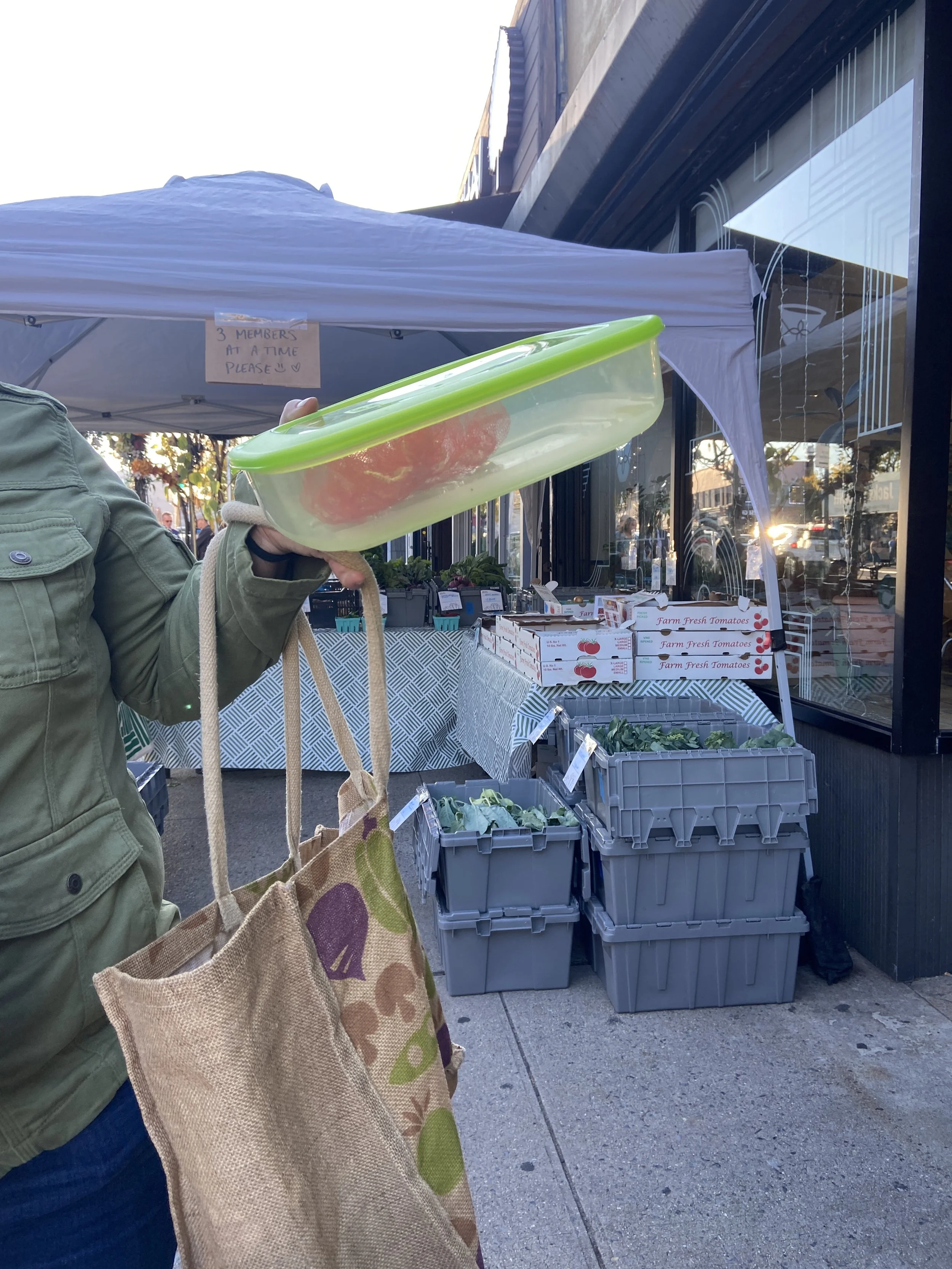
We’ve seen members bring rigid reusable plastic containers to get larger tomatoes home safely, reusable bags for greens, or the final destination containers to reduce repacking at home. Do what makes sense for you and feel free to leave our containers with us!
-
Tomatoes: Unripe tomatoes should stay out on the counter, not in a container, and out of the sun, until they are ripe. Once fully ripe, tomatoes can be refrigerated for several days without impacting quality.
Greens: In the fridge, in our cellophane bags, or in your own resealable bags. If your fridge tends to be drier, a damp paper towel can be used to extend shelf life.
Herbs: Many herbs benefit from having their cut ends in water, a plastic bag over the top, and stored in the fridge. If space is limited a damp paper towel in a zip bag can replace water. Basil should be in water on the counter, with water replaced every few days like cut flowers.
Onions & Potatoes: store in a dark, cool, dry place. Once one goes bad it will turn the rest, so check them occasionally. Be sure NOT to store your onions next to your potatoes; they don’t like that.
Carrots and other roots: Roots have a tendency to dry out once out of the soil, but you can get a long shelf life by wrapping them in a damp towel and sealing them in a zip back in the fridge.
